Day 0: 30 Days Back to Basics
Day 0
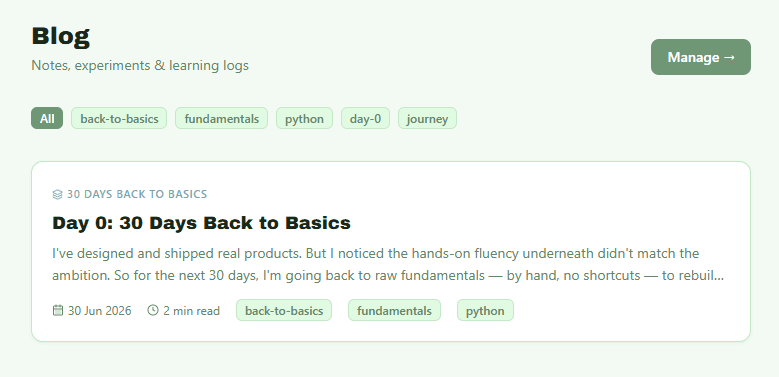
I design and ship products. This site, DiGift, a handful of other things you can find around here, all real, all live, all things I architected and pushed into the world. I lean hard on every tool available to do that, including AI, because that's honestly how building works now.
But somewhere along the way I noticed something I wasn't comfortable with: I could draw the blueprint, but I couldn't always lay the bricks myself. I knew what a hash map was for, but I'd never built one. I could describe recursion in an interview but couldn't always trace through it by hand without help. The vision was real. The hands-on fluency underneath it wasn't as solid as it needed to be.
So starting tomorrow, I'm spending the next 30 days doing something deliberately unglamorous: going back to raw fundamentals, by hand, no AI writing the code for me. Variables and loops on day one. Data structures built from scratch by week two. Recursion, algorithms, and complexity by week three. A small project, fully mine, every line typed and understood, by week four.
This isn't a reinvention. It's reinforcement. Same house, better foundation.
Why document it publicly
Because I think the struggle is more useful to show than a highlight reel. Anyone can post "I learned recursion today." I'd rather show the 40 minutes I spent confused about why a recursive function wasn't returning what I expected, and what finally made it click. If you're trying to figure out where I actually am as a developer, that's a better signal than a polished portfolio that hides how I got there.
What I'm doing, concretely
- Week 1: mechanics and raw fundamentals, variables, control flow, functions, first scripts written from a blank file
- Week 2: data structures, built from scratch, stacks, queues, linked lists, hash maps
- Week 3: recursion, sorting algorithms, and learning to actually reason about complexity
- Week 4: architecture and a small capstone project, fully hand-built, plus a look back at what I'd redesign in my existing projects now
One language throughout. Python, because the goal this month is learning to think, not collecting syntax across languages.
What I'm not doing
I'm not disavowing AI-assisted building. I'll keep using it the way most working developers do, going forward. This month is specifically about making sure that when I direct a tool, debug a tool's output, or step in by hand, I actually know what's happening underneath, not just that it works.
Day 1 starts tomorrow: variables, loops, and an honest attempt at FizzBuzz. Follow along if you want to see exactly how that goes.